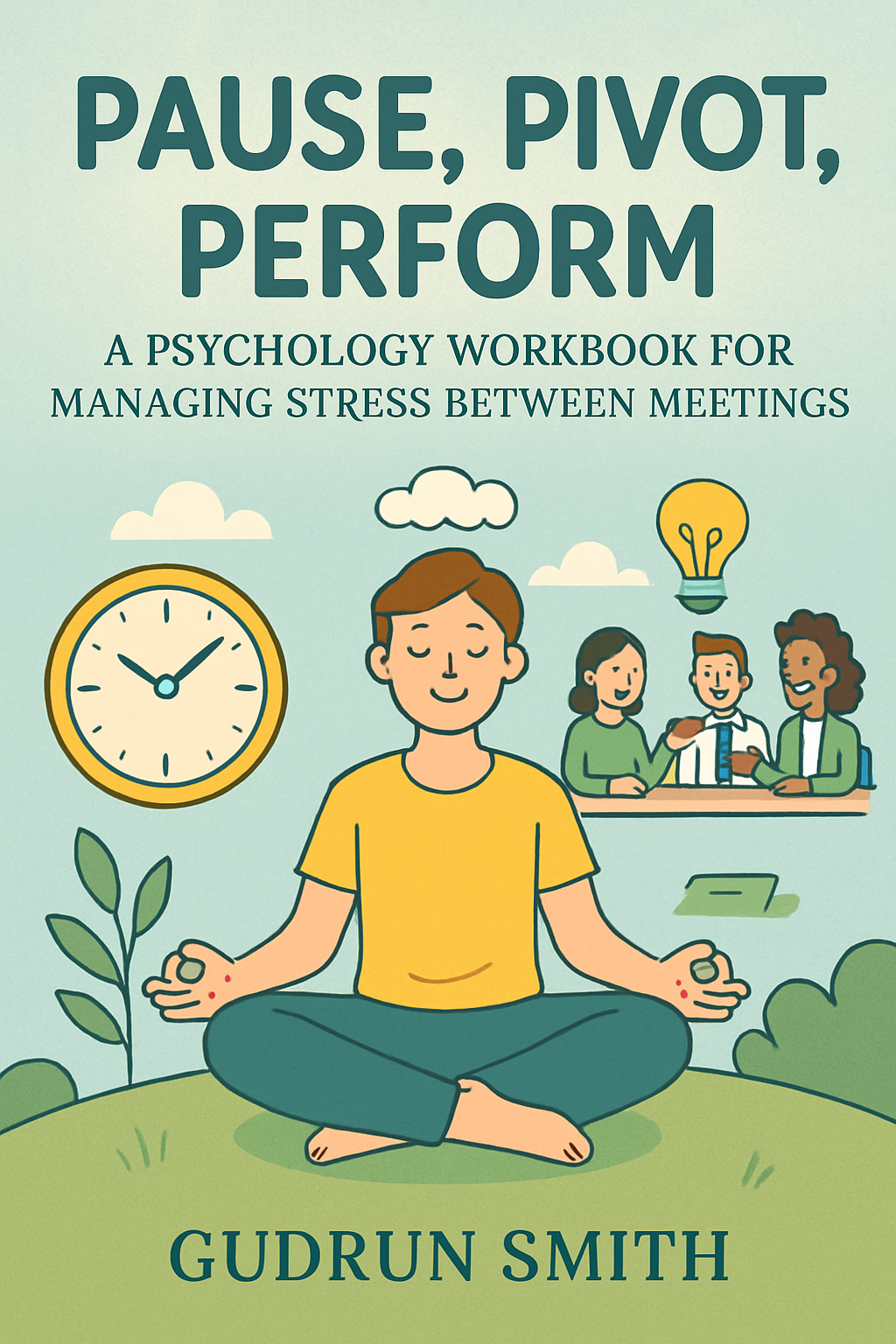
Pause, Pivot, Perform is a practical psychology workbook for managers, team leads, and knowledge workers who feel permanently caught in the churn of back-to-back meetings. Written by psychologist and coach Gudrun Smith, it translates neuroscience research on attention, emotion regulation, and stress into micro-practices you can use in real time — between calls, in hallways, or in the five seconds before you hit send.
The book is built around a three-step framework: Pause to downregulate your nervous system, Pivot to reframe or reprioritise, and Perform with focused intention. Each step is evidence-based and designed for real work conditions — time pressure, cognitive load, and interpersonal friction. Rather than long meditation sessions or weekend retreats, the tools here fit into 20 to 90 seconds and compound quietly over the course of a busy week.
Across twelve chapters, the book moves from individual micro-practices to team and organisation-level tactics. You will find breathing scripts, body scans, sensory anchors, rapid reprioritisation checklists, meeting experiment protocols, reflective journal templates, and a full 30-day integration plan. The final chapters show how to scale what works across teams, design shared norms, and run simple experiments that reduce meeting overload without sparking a culture war.
Chapter Overview
Chapter 1 — The Pause-Pivot-Perform Framework
Introduces the core three-step method. The pause halts the automatic reactive response by first downregulating the body. Pivot creates a short structured space for reframing, reprioritising, or renegotiating. Perform turns, clarity into focused action using decision rules, time boxes, and a simple visual flowchart. Together the three steps take seconds and change outcomes.
Chapter 2 — Micro-Pauses: Fast Downregulation Tools
Covers the science behind why brief physical resets work and delivers a menu of 20 to 90-second techniques you can use anywhere. Includes solo and team breathing scripts, seated body scans, progressive tension-release exercises, sensory anchors, and two rapid resets for use directly after heated exchanges.
Chapter 3 — Micro-Pivots: Reframing and Reprioritising on the Fly
Shows how to interrupt the threat response with small cognitive shifts. Covers quick reframing lines that reduce defensiveness, a 60-second rapid reprioritisation checklist, three-frame task mapping (Urgent, Important, Deferred), and role-specific scripts for renegotiating scope mid-meeting as a leader, contributor, or facilitator.
Chapter 4 — Micro-Performs: Focused Execution After a Reset
Explains how to convert a reset into measurable forward motion using short, intense execution sprints. Covers the power of the first ten minutes after a reset, 20/5 and 40/10 sprint formats, the three-question decision rule (Act, Delegate, Defer), and micro-rituals, Start Statements, and visual cues that sustain attention across a busy day.
Chapter 5 — Pre- and Post-Meeting Check-Ins
Provides ready-to-use scripts for leaders and attendees that set purpose, reduce ambiguity, and capture next steps. Includes a 60-second post-meeting debrief structure, fast attribution questions to identify what blocked a decision, and a one-line action template for immediate follow-up.
Chapter 6 — Meeting Overload Experiments
Treats meeting culture as something to test rather than complain about. Walks you through designing a 2 to 4-week experiment on one recurring meeting, with tools including an async versus live check-in A/B test, role rotation, strict agenda limits, and standing meeting trials. Includes simple measurement prompts to track what actually improves.
Chapter 7 — Designing Micro-Habits That Stick
Explains how to attach tiny practices to the natural anchors in your meeting routine — before, during, and after calls. Covers how to design clear binary triggers, use visible artefacts to nudge behaviour, leverage social cues for faster adoption, reward progress, and recover quickly when habits drift.
Chapter 8 — Scripts and Language That Calm and Redirect
A practical library of short, work-ready phrases for tense moments. Includes reframe prompts to shift group focus from blame to problem solving, one-sentence feedback formulas for use after difficult exchanges, and boundary scripts that protect your time without closing down collaboration.
Chapter 9 — Short Reflective Templates and Journals
Introduces lightweight reflection tools that turn meeting noise into a trail of clear decisions and learning. Covers the Two-Minute Post-Meeting Reflection (Highlight, Lesson, Action), a one-line micro-journal for tracking energy, focus, and stress, and weekly synthesis prompts to spot triggers, identify patterns, and plan small experiments.
Chapter 10 — Managing Cognitive Load Between Meetings
Focuses on the short gaps between calls and how to use them strategically rather than filling them with low-value tasks. Covers the 4D Rule for rapid inbox triage (Do, Delegate, Defer, Delete), the Now List and Later List for externalising mental load, Calendar Armour for scheduling protective buffers, and consolidation blocks for stopping chain meetings.
Chapter 11 — A 30-Day Practical Integration Plan
A week-by-week guide to embedding the Pause, Pivot, Perform method into daily working life. Week 1 introduces the micro-pause and meeting scripts. Weeks 2 and 3 add habit-stacking and simple A/B tests. Week 4 and beyond focuses on scaling what works, personalising for different roles, and embedding new norms across the team.
Chapter 12 — Scaling Resilience: Team and System-Level Tactics
Shows how to move from personal tools to shared team practices. Covers designing a short team pact, running organisation-level experiments to reduce meeting demand, using capacity budget models, and a Train-Practice-Measure approach with role scripts and team metrics to make resilience a structural feature rather than a personal effort.


Gudrun’s Books
…
What You'll Get:
A portable, ready-to-use toolkit that fits your calendar rather than fighting it. Specifically:
• Fast downregulation techniques you can use in under 90 seconds, including breathing scripts, seated body scans, and sensory anchors for heated moments
• Reframing and reprioritisation tools that convert reactive stress into clear next steps in under a minute
• Pre- and post-meeting scripts that reduce ambiguity, capture decisions, and prevent follow-up drift
• A three-question decision rule (Act, Delegate, Defer) to triage tasks without rumination
• Focused execution strategies including 20/5 and 40/10 sprint formats, Start Statements, and visual cues that sustain attention
• Meeting experiment protocols to reduce overload — including A/B tests, role rotation, agenda limits, and consolidation blocks
• Short reflective templates and a micro-journal to track energy, focus, and stress patterns over time
• A 30-day step-by-step integration plan to embed the habits into your working routine
• Team and organisation-level tactics to scale resilience beyond the individual